Category Archives: fantasy

a few thoughts on Tolkien

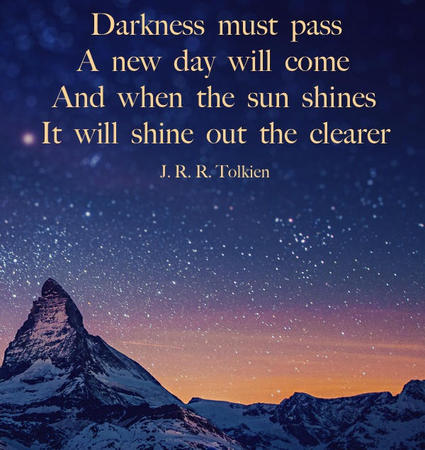
tolkien-darkness-must-pass

JRR Tolkien was born 125 years ago today, on January 3, 1892 (for the arithmatic-ly challenged).

My mother dragged me to see the Fellowship of the Ring in 2001. I was 13. She really did have to drag me, using the sound reasoning that she’d gone to every damn stupid god forsaken terrible film I’d ever want to go to as a kid, and I was going to come whether I liked it or not.

At the start I was outraged I was being dragged to a three hour film I knew nothing about and had no interest in.

By the end I was outraged I’d sat through a three hour film and they hadn’t answered any questions.

My mom wouldn’t tell me what happened next and said I’d have to read it or wait til the next film. I was outraged further.

But I started The Hobbit on December 21, 2001 and finished The Return of the King on August 22, 2002. I was a slow reader as a kid.

And man, those books and films changed my life.

Not in a “I’m a new person” kind of way, although I did adopt the “not all those who wander are lost” quote as a philosophy of life. I don’t think it changed my outlook on life. It did change my outlook on stories. I compare every epic saga to that of the Fellowship’s. I don’t even do it on purpose. But that’s the standard – from the personal, inner conflicts of the characters to the epic consequences of the struggle, other stories I’ve read lack the world building, the scope and the depth of Lord of the Rings. Peter Jackson’s adaptations are also possibly the greatest films I’ve ever watched in terms of grandeur and scale and faithfulness to the source material.

I’m not so devoted I’ve done things like read The Simarillion or The Children of Hurin. Or The Appendices. DEAR GOD, THE APPENDICES. But I like that they’re there if I ever want to read them.

And I do recognize greatness when I read it, and Tolkien may be the greatest.

So happy birthday to an all time great and one of my all time favorites. Thanks for a story that has given me something to bond with my mom over. And my friends. And my teachers. And the rest of the world. It’s been the best gift.

tolkien-wander-quote

Four and Twenty Blackbirds [An Eden Moore Story]

Four and Twenty Blackbirds by Cherie Priest is a story that I really, really, really wanted to like. And I thought I did for awhile.

image

From Amazon:

The classic Southern gothic gets an edgy modern makeover in Priest’s debut novel about a young woman’s investigation into the truth of her origins. What Eden Moore digs up in the roots of her diseased family tree takes her across the South, from the ruins of the Pine Breeze sanitarium in Tennessee to a corpse-filled swamp in Florida, and back in time to the Civil War, when the taint in her family bloodline sets in motion events building only now to a supernatural crescendo. Priest adds little new to the gothic canon, but makes neo-goth chick Eden spunky enough to deal with a variety of cliché menaces—a scheming family matriarch, a brooding Poe-esque mansion and a genealogy greatly confused with inbreeding—that would have sent the genre’s traditional wilting violets into hysterics. Eden is a heroine for the aging Buffy crowd, and her adventures will play best to postadolescent horror fans.

I’ve been looking forward to this book because of both the title and the cover art. This is another entry from my Women of Fantasy book club. The cover art is a bit spooky, which I love and begs me to read. Also, in my own weird way, I’m obsessed with nursery rhymes. They all have secret meanings. I actually bought my mom a book on secret nursery rhyme meanings, which she asked for, but which I will probably get to first.

So, I dove into this story. I found out too late that the title has little to do with the actual story. Disappointing.

…beware, mild spoilers ahead!

I enjoyed the premise. Eden sees ghosts who try to protect her from him. Who is he? As Eden gets older, she discovers more and more about her history, which is very mysterious, of course, and she discovers who he is.

I liked Priest’s writing style. I also enjoyed, deeply, the relationship between Eden and her aunt, Lulu. The idea that sometimes things change and never go back/are never the same again is something I relate to and understand completely, having gone through a life-changing family experience.

The conflict with Malachi I found enjoyable. He’s like some damn obnoxious bug that just wouldn’t.go.away. As well as the old woman, Tatey. They were amusing.

But the biggest problem I had with the story was that I didn’t like the resolution. It just didn’t seem realistic to me – at all, in any way. I don’t want to say that I expect total reality in my fantasy series, but this is urban fantasy, and I expect some sense of “this could really be happening.” Considering these people were mere mortals living in modern America, the idea of someone surviving for 150 years through a concoction of blood, marsh grass, and chanting (as well as a child being reincarnated over and over again), I just didn’t buy. There wasn’t enough explanation for me to really believe that the antagonist harnessed his magic. In Prospero Lost and Prospero in Hell, the magic makes sense. You understood how it worked, and why. Here, it’s just evil black magic that just kind of…goes on. It was revenge, it was a desire for immortality, it was…just not something I could realistically believe. The foundation of the magic just wasn’t solid enough, and the motives for the magic weren’t well justified. There were just a whole bunch of half reasons that didn’t seem to fully develop.

The second major problem I had with the book: I didn’t like Eden. I thought I did, at first, but as I reflected on the book, the more and more I just couldn’t like her. As someone who is around Eden’s age when the story takes place, I felt as though I shouldn’t be aware of exactly how stupid she was. There were a whole bunch of moments where I decided this girl was really too stupid to be living. She was smart in a lot of ways, but not smart enough to come out of the experience alive. I also felt Priest spent a lot of time having Eden talk about her own attributes instead of showing Eden’s attributes. Some of these attributes also seemed to come out of nowhere as Eden needed them – it was very Mary Sue.

(Side note: I found Cora the most interesting of the secondary characters, and would have liked to see her relationship with Eden develop, but she disappeared early on. The end of her story came so suddenly and disappointingly that I was a little rattled by it – the way it was completely glossed over and thrown in there, as though it was just a detail that needed to be wrapped up. Eden doesn’t even stop to feel a pang of sadness or anything. The time dedicated to Cora early on warrants a bit more than the one sentence mention towards the end of the book.)

But even with Eden’s slight Mary Sue-ness, there was something about Eden that was just obnoxious. I don’t know if was the way she thought she was tough (but stupid, which she never managed to mention) or the way she seemed to go out of her way to be the typical “I know everything” young adult, but it was really.really.annoying.

The last major issue I had with the story was the fact that to understand it, you have to literally diagram Eden’s family tree. Too many people who were related distantly or in more than one way (we’re talking brother/cousins here). It was ridiculously hard to keep track of who was who and what their relationship was to everyone else. I had to keep going back and rereading parts just to understand who was related to who and how they were related. I’m not a stupid person, but I couldn’t keep it straight in my head, and I found that irritating.

Overall, I can’t say I felt good at the end of this book. I really wanted to. I liked the premise a lot. I liked the magic, the ideas, the very weak foundation the story was built on. The book was too short to really get into that foundation, which was disappointing, and is keeping me from really recommending the book. And unlike at the end of Prospero Lost, I don’t feel any real need to go on to the second story.

Yes, there are two more Eden Moore stories…that I’ve added to my Amazon wishlist, by the way, but I don’t really intend to buy. Someone might buy them for me if they’re looking for gift ideas, that’d be fine. I’d read them. If I happen upon them at a used bookstore or a library sale (or something like that) for a good price, I’ll pick them up. Until then, farewell Eden. It’s been real.

Prospero Lost & Prospero in Hell [Prospero’s Daughter, Books 01 & 02]

My latest book obsession is the Prospero’s Daughter series by L. Jagi Lamplighter.


I read the first one, Prospero Lost for my Women of Fantasy book club.

The premise, pulled from a Publisher’s Weekly review on Amazon,  is this:

Four centuries after the events of  The Tempest, Prospero’s  daughter Miranda runs Prospero Inc., a company with immense influence in  the supernatural world. When she discovers a mysterious warning from  her father, who has gone missing, Miranda sets forth accompanied by Mab,  an Aerie Spirit manifested as a hard-boiled PI, to warn her far-flung,  enigmatic siblings that the mysterious Shadowed Ones plan to steal their staffs of power. Every encounter brings new questions, new problems and  a greater sense of what’s at stake.

Also noteworthy in the premise: the Prospero family is immortal.

…mild spoilers ahead, beware!

I was intrigued by the first one, but somewhat disappointed with it. All the mysteries were set up and there was all kinds of background. The background was interesting. It really was. Lamplighter brilliantly weaves Shakespeare, fantasy, mythology into one coherent, connected, somewhat complicated story. But there weren’t any answers in the book itself. I’m one of those people, who, when reading a series, feels that the reader should get something to hold on to from book to book. While the book was spectacularly set up, it gave no answers.

What really saved it was the characters. The heroine, Miranda, isn’t actually very likable. She sees nothing wrong with enslaving an entire species (a supernatural species, but a species none-the-less) and is very cold to just about everyone except her brother Theophrastus (or Theo, for short). She has a soft spot for her brother Mephistopheles (Mephisto, for short) and for Mab, the company detective, who is one of the spirits employed by her family to run their company. But Mephisto is mad, although very endearing, and Theo is cranky in his old age (he’s shunned immortality). Miranda’s sister, Logistilla, comes off as an absolutely horrendous human being, at least to me. Mab was a bit cranky himself, but mostly about his enslavement. Understandable.

But the way the characters interact, and why they are the way they are, really drew me into the story. Lamplighter’s writing and descriptions were my favorite types – rich but not dense. I’ve noticed that some fantasy writers can crush their own stories under the weight of their own words. Lamplighter doesn’t do that here.

I disliked, greatly, Miranda’s constant praying to her Lady Eurynome – who was a Unicorn and a goddess and…read the book, it’ll make more sense. But she guided Miranda in every instance of trouble. Miranda is supposed to be smart and capable, but her constant “praying for guidance” kind of undermined that. It made me feel like maybe Lamplighter had no way to get her characters where she wanted them to be without relying on this divine intervention, which aggravated me. Can’t a woman just be smart and/or intuitive without having to depend on divine intervention? This was really the only aspect of the story I didn’t enjoy.

But I’m a sucker for family drama, ancient magic, and dark secrets. I was fascinated by the fact that Erasmus (another younger brother – after five hundred years, there are nine Prospero children, and Miranda is the oldest) despises Miranda, and has for centuries, but she has no idea why. So naturally, I picked up the second one as soon as I was able.

The adventures in the first book continue immediately in Prospero in Hell. It was a better book. More action, less set up, and we got to meet the rest of Miranda’s family. I like the cast of characters. Theo is less cranky and infinitely more sexy in this book. He’s pretty high on the list of fictional characters I’d totally sleep with, especially when he returns to his youthful self.

There were some really great secondary surprises in here. I figured Gregor wasn’t dead, but I didn’t figure that he wasn’t dead the way it turned out it wasn’t dead. I don’t want to give too much away, but there you have it. The surprise for me wasn’t that Gregor wasn’t dead, it was why he wasn’t dead. Although more questions were raised in this book, and we still don’t meet  the “Dread Magician Prospero,” we got a lot of answers, which was really helpful as a reader. It’s frustrating to never have your questions answered.

Miranda was much more sympathetic in this book, and she’s becoming a better person, although why remains unclear. Erasmus is completely awful to her. But it’s quite obvious that in spite of the fact he has some gripe with her (that’s yet to be revealed except that he says she took something from him), he loves her because she’s his sister if nothing else. He blames himself when she’s brutally attacked by a demon. He also restores her hair to its natural dark color, which he’d previously turned silver with his staff.

All the Prospero children have magical staffs that have specific powers. You can read more about the family here and more about the staffs here. The staff page has some spoilers, so be warned. I don’t think the spoilers there are that huge, but yeah, fair warning. The family/staff stuff is pretty complicated, so I don’t want to get too much into it myself.

While I had some gripes with both books, my overall impression of them was positive. I felt that these two books could have worked as one book. They seem like different parts of the same book, because of the way the first book doesn’t give any answers and the second book gives you a lot of them. But overall, both these books pulled me in and I blew through them – a really enjoyable experience.

The third book, Prospero Regained, is set to come out September 13th of this year. Who’s excited? I am.