Tag Archives: genre: fantasy

Something Wicked This Way Comes

Something Wicked This Way Comes is the first Ray Bradbury book I’ve attempted since Fahrenheit 451 in high school. I hated Fahrenheit 451. It was something about the way they taught it in Yorktown High School, because all my Yorktown friends hated it and all my Somers friends, who went to Somers High School, loved it.

Anyway, I never felt inclined to read another Bradbury book. “Overrated” came to mind when I thought of Fahrenheit 451. But in the end I caved.

I went with Something Wicked This Way Comes because, and this will become more evident with later book choices in 2018, I started looking for dark fantasy/horror/sci-fi books. Not so much sci-fi, but I didn’t rule it out.

Something Wicked This Way Comes is the first of those books. I think I picked it because I read that Stephen King liked it, and because it was available on audiobook at the very moment I needed a new one.

I liked it. Mostly. It was a little slow for me. The basic premise is that the town two 13 year old best friends live in (their names are Will & Jim) is visited by a traveling carnival. The carnival is run by a man named Mr. Dark, who is especially attentive to Jim.

After seeing several disturbing things at the carnival, the boys are eventually kidnapped by Mr. Dark, who has been recruiting people into his carnival for a long time, and, basically, have to fight their way out.

It was an interesting book, a lot of allegory for good and evil, and, as I said, a little slow. I will say that the whole thing thoroughly creeped me out in a lot of ways, so mission accomplished there. I don’t like carnivals. At all. But I think my feelings about the story overall may have been influenced by my dislike of the narrator of the audiobook. I didn’t enjoy his performance much.

That said, everyone raves about Ray Bradbury. I enjoyed this novel far more than Fahrenheit 451, but the little voice in my head still whispers “overrated.”

American Gods

Neil Gaiman’s American Gods is a book I first read at the recommendation of a friend in 2007. I revisited it because the TV adaptation started airing in 2017.

Let’s just say they are two very different things, although since I think of them that way, I have no preference for one over the other.

I enjoyed revisiting the book. One of the arguments against Gaiman that I’ve seen is basically that he tells different variations of the same story over and over – basically a (white) guy becomes the hero in a secret world not visible to most of the rest of the population.

This story doesn’t bother me, and I tend to like the way Gaiman tells it.

Shadow Moon was THISCLOSE to getting out of prison and home to his wife when he’s released three days early. His wife and best friend die in a car accident. Later, Shadow finds out his wife was cheating on him with his best friend. I won’t retell the whole story here but basically this revelation sets Shadow adrift and pushes him into the employment of Mr. Wednesday as his “bodyguard.”

Ultimately, Shadow finds himself caught up in battle between the Old Gods – the gods we studied as part of our high school history and English classes – and the New Gods – the gods of money, media, and globalization.

I feel like I somehow missed a lot of the book when I read it in college, so it was sort of like discovering a new book all over again. I had completely forgotten large portions, and some of the portions were new, because the audiobook was the 10th anniversary edition with the author’s preferred text which included an additional 12,000 words and was performed by a full cast. It was very well done and I thoroughly enjoyed rediscovering it.

Criticism of Gaiman as a guy who tells different versions of the same story over and over is somewhat valid, but I find his insight into America uniquely interesting in this book. As someone who is now 10-12 years older than I was when I read it the first time, and has paid a lot more attention to the country I grew up in over those years, Gaiman’s take on the United States as a “bad place for Gods” is both the opposite of what people would think and also incredibly true.

Power belongs to the people/things men give it to. While you would think the United States of Jesusland was an excellent place for what we think of as the Christian God – it still is in many places – it’s bad in the sense that things constantly change here, with power constantly moving from one thing to the next as society and its opinions evolve. The “new gods” of money, media, globalization are hugely powerful now, but eventually their power will fade too. Maybe not entirely and maybe not in our lifetime, but they will, eventually, fade away as well. In a way, it’s already starting, between claims of “fake news” and a growing backlash against money in politics, and the instinct of many ordinary Americans to fight against sending jobs overseas.

As the United States continues to look for itself and continues to try to find itself, things will continue to change. As Gaiman points out, the United States is the only place in the world that doesn’t have a set definition of what it is, or necessarily even cares much.

“This is the only country in the world,” said Wednesday, into the stillness, “that worries about what it is.”

“What?”

“The rest of them know what they are. No one ever needs to go searching for the heart of Norway. Or looks for the soul of Mozambique. They know what they are.”

It’s an incredibly relevant take lately, particularly as we approach a presidential election in 2020.

American Gods remains firmly in its position of my second favorite Gaiman book. I’ve read quite a few. It was nice to revisit, and I’m sure I will revisit it again.

The Hobbit

Ah yes, one of my old favorites: JRR Tolkien’s The Hobbit.

I goofed though. It was a full BBC radio production of the book, not a straight reading of the text. The Wikipedia entry on the production says the script remains close to the text, but I didn’t like it. The voice actors of the dwarves annoyed me, Gandalf sounded ridiculously arrogant instead of kindly and gentle, Bilbo had a lisp, I felt like the whole thing was pretty far off from the novel even though the internet swears that isn’t the case.

It was only 4 or 5 hours long too. I don’t know if that would be true in a straight reading of the text. In this case, since I wasn’t much enjoying the production, it’s short length meant less suffering.

I love The Hobbit. I love it. I love Lord of the Rings, I love Tolkien.

I hated this. I know it’s the “classic” radio production. I know, I know, I know. I didn’t enjoy this. I disliked the production so much I could barely focus on the story, which I love.

I’d have preferred a straight reading of the text, or maybe a different production. I came across another “full production” recording of a book this year that I thought was excellent. But this? I couldn’t. I just didn’t like it. Someone must love it. I just don’t. I don’t know how they ruined The Hobbit for me, but they did. Bad job, BBC.

The Magicians

I listened to Lev Grossman’s The Magicians because the book I originally wanted to listen to wasn’t available at the time and this was labeled as “the adult Harry Potter.”

I’ll stick with actual Harry Potter.

It’s weird though. I didn’t hate this book. The story was interesting, I liked the premise, and there was magic, terror, and some pretty good actions scenes. I feel like in some ways it was a lot more true to real life – particularly the parts about being in a hyper-competitive, highly exclusive school (studying is something that JK Rowling glosses over in the HP universe – only Hermione’s study schedule is ever detailed and not many words are devoted to that either – and Hogwarts is the public school of magic in the UK, meaning everyone goes whether they’re good at magic or not).

But there was a lot of stuff that was tough for me to get past. Our hero – anti-hero? – is Quentin. And Quentin is suffering from depression. Boy oh boy, is he suffering from depression. And consequently, so are we. In addition, Quentin is selfish, brooding, narcissistic, and an overall miserable prick. He’s not very likeable.

This, in itself, isn’t necessarily a problem. The thing is, everyone at this magic school Quentin attends, called Brakebills, is a huge asshole in some way or another. Seriously. There is almost nobody to like. At all. I don’t mean that they just have some asshole qualities. All of them are fucking awful in almost every way. They are also brave and smart, which makes them just this side of tolerable, but overall? They’re all negative, brooding, asshole-y douchebags who have too much free time and drink too much.

The other thing I struggled with too was the length of the novel. According to Amazon, it’s 432 pages. I don’t remember how long the audiobook was, but by the end I just wanted it to be over. It drags out too long. Grossman crams 5 years of schooling into this novel with much of it not being particularly noteworthy. Magic is hard, complicated to learn, and requires endless hours of practice and study. But I feel like, maybe, we don’t need to go through every hour? It wasn’t well paced. For every good scene of significance, there was one that was bad and could have been cut. Maybe two.

Interwoven into this whole thing is Quentin’s obsession with Fillory, a Narnia like place he read about in stories as a kid that featured a family called the Chatwins, specifically the children. As I said, it’s very Narnia-esque. This obsession eventually becomes relevant (and it takes quite awhile for it to become relevant) when Quentin and his friends discover they can travel to Fillory. I honestly wish Grossman had gone more into the Chatwins. They couldn’t have been worse than the main characters in this story.

Anyway, Quentin manages to be miserable in Fillory too – no joke. The magical land he’s been obsessed with since childhood, and Quentin manages to fucking be miserable there. There’s a villain in Fillory, called ‘the Beast’, who Quentin and his friends end up seeking to outrun and destroy. They’d met the Beast before in school, when (IIRC) a spell goes awry and the Beast eats a student before the faculty can vanquish it.

Magic is much more dangerous in this book than in the Harry Potter universe because it seems to be a lot less…stable, I guess is the word I’m looking for? Or maybe it’s more wild? Anyway, in Harry Potter books, you use the right gesture with your wand, say/think the right incantation, and boom, spell. Intent of the spell also matters. If you’re going to cast an unforgivable curse, you know you’re doing that. In The Magicians universe, magic has a lot of complex variations that change with things like phase of the moon. Messing up a spell near the wrong body of water, even one meant to do good, can be catastrophic. Spells gone awry is hinted at as a possibility in the Potter universe (Luna’s mother dying as a result of an experiment gone wrong) but in this one it has real consequences when the Beast is released and kills a student.

Anyway, the whole thing is eventually resolved in a neat little bow. Okay, not that neat, but a bow all the same. Grossman clearly didn’t know he’d be writing a trilogy. Yes, there are two more ‘Magicians’ novels – The Magician King and The Magician’s Land.

I’m not sure I’m going to get to the last two books of the trilogy. I thought I was. But even though I didn’t hate this book, I can’t really say I liked it either. Plus my favorite character became a freakin’ niffin. And no. I have zero interest in the television adaptation.

Legends of the Dragonrealm, Volume I

Richard Knaak’s Legends of the Dragonrealm, Volume 1 was another book I proudly quit in 2017.

I am obsessed with dragons. Obsessed. You wouldn’t know it looking at me – I don’t have a dragon tattoo or any weird piercings or anything of the sort. I have no pictures of dragons up anywhere. I have some dragon figurines/statues/sculptures/whatever and some jewelry. But I’m obsessed with dragons. I have been since I was a little kid. I look at pictures of them, for awhile I tried to draw them, I know a ridiculous amount about them considering they’re not real, and I read about them.

This book has been sitting on my shelf forever. I bought it for a great price when Borders was going out of business and that has to be…jeez…6 years ago now? This summer, I finally sat down and started it.

It.was.awful.

Not the dragons. The dragons were interesting. So were the maps in the front of the book.

Everything else? SNOOZEFEST. Cabe, the “hero,” was very boring. Supposedly he was a magician? Or a wizard? But he didn’t know. Also, something about his hair. And his dad, who was a dark wizard? And a beautiful sorceress who was going to help him defeat his dad? And a gryphon king. Or something.

It was all too boring for words. I was at page 200 of about 900 when I put the book down and decided life was too short. I’m glad I only bought the one book and not the second and third volumes, which I think were also available at the time. Sometimes my mother is right.

“Why don’t you see if you like it before buying Volume II and Volume III?”

Saved some money there.

I’m sure someone out there likes that book. I’m sure multiple people do. It gets 4 out of 5 stars on GoodReads. I’m not one of those people.

City of Dark Magic

Ah yes. The last book I read in 2016: City of Dark Magic by Magnus Flyte. I picked this one up at Barnes & Noble because it was $6. As good a reason as any to pick up a book, right?

I have a couple of issues with it, although I didn’t hate it.

Basically, music doctorate candidate Sarah Weston, who helps support herself by giving music lessons to/nannying the precocious only child of a wealthy Boston family ends up in Prague for the summer when her doctoral adviser, who was already in Prague, mysteriously dies. He was cataloging and chronicling possessions of one Prince Max, who has just regained possession of a castle from the Czech government after the Nazis took possession and occupied it during World War II. Sarah and a number of other experts in their fields are staying at the castle to do this research so Prince Max can open a family history museum.

Sarah’s adviser, and later Sarah, end up looking for evidence of Beethoven’s ‘Immortal Beloved,’ which is apparently a real academic mystery, where nobody knows who the addressee of this famous love letter that Beethoven wrote actually is. There are several theories, which the book delves into for the sake of fiction.

After her arrival in Prague, Sarah begins to suspect her adviser was murdered. That theory is later confirmed when someone else close to the project is murdered, and so Sarah finds herself at the center of an escalating mystery as a series of murders threatens this important summer project.

Now, this is clearly a fantasy book, so the alchemy, the ageless servant, the nearly clairvoyant precocious little girl, etc… I was ready for.

The detours into Sarah’s sex life, particularly early in the story, I was not only not ready for, I felt they added to almost nothing except the author’s word count.

I know that sex is part of life and having had it before, I like it as much as anyone. But I don’t really want to read about it in detail. I find the writing is generally cringeworthy (as this was) and I find that most of the time, it’s not relevant. In this case, Sarah gets horny on the plane and blah blah her sense of smell and blah blah blah ends up banging a guy who she thought was another guy in a closet or something at the castle during dinner.

To me, this is the least interesting “mystery” in the whole book, because I really don’t care. Sure, this ends up being somewhat relevant but you could have left it out entirely and I wouldn’t have had to roll my eyes and wonder if I should bother continuing. This happened maybe 50 pages into the book? I don’t read romance for a reason. I don’t find it interesting. I didn’t find this aspect of the story interesting. I found it rather annoying.

Sarah was something of a Mary Sue as well, but it wasn’t so unbearable I felt I had to put the book down. It was a little annoying sometimes.

The resolution of the story was a little strange, and I think I must have missed a part while skimming (I tend to do that). There’s a US Senator involved in this whole thing, who is a sociopath, but I don’t fully understand why she’s involved. Anyway, she gets sucked into a vortex of doom and that’s basically how her plot line is resolved. Not the greatest writing but also not the worst.

Actually, the whole book was not the best book, but also not the worst. One of the things it did have going for it is that it wasn’t very long, so it wasn’t so slow that I had to put it down, unfinished, a mistake thus far only reserved for the books I really find boring.

The premise of the story was interesting enough for me to keep reading even though a couple of things early on turned me off. I’m glad I did, because while some of the novel really fell flat, there were enough fun elements to make consider reading the sequel. I’m a sucker for historical mysteries – Shakespeare’s lost plays are some of my favorites.

I also liked the setting. I haven’t spent a lot of time in Europe, but I’d like to, so it was nice to spend a story in Prague. Prague is one of those cities everyone seems to visit and talk about in college. I never went, and I think this is the first book I read that was set there.

Oh. So yes, there’s a sequel. It’s called City of Lost Dreams. That takes place in Vienna. I may pick it up, but I’m in no rush.

This is a good – for lack of a better term – beach read. If you’re a huge fantasy nerd who wants something denser and more detailed, this isn’t for you. It’s pleasantly surprising, but it isn’t anything fantastic.
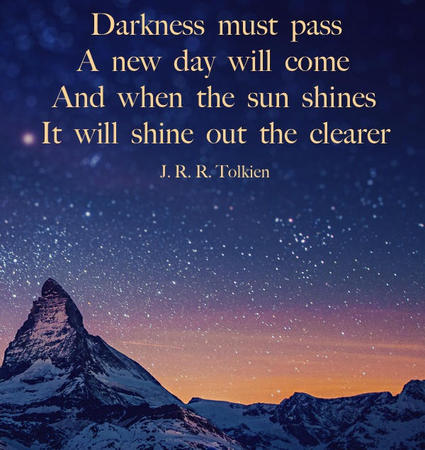
a few thoughts on Tolkien

tolkien-darkness-must-pass

JRR Tolkien was born 125 years ago today, on January 3, 1892 (for the arithmatic-ly challenged).

My mother dragged me to see the Fellowship of the Ring in 2001. I was 13. She really did have to drag me, using the sound reasoning that she’d gone to every damn stupid god forsaken terrible film I’d ever want to go to as a kid, and I was going to come whether I liked it or not.

At the start I was outraged I was being dragged to a three hour film I knew nothing about and had no interest in.

By the end I was outraged I’d sat through a three hour film and they hadn’t answered any questions.

My mom wouldn’t tell me what happened next and said I’d have to read it or wait til the next film. I was outraged further.

But I started The Hobbit on December 21, 2001 and finished The Return of the King on August 22, 2002. I was a slow reader as a kid.

And man, those books and films changed my life.

Not in a “I’m a new person” kind of way, although I did adopt the “not all those who wander are lost” quote as a philosophy of life. I don’t think it changed my outlook on life. It did change my outlook on stories. I compare every epic saga to that of the Fellowship’s. I don’t even do it on purpose. But that’s the standard – from the personal, inner conflicts of the characters to the epic consequences of the struggle, other stories I’ve read lack the world building, the scope and the depth of Lord of the Rings. Peter Jackson’s adaptations are also possibly the greatest films I’ve ever watched in terms of grandeur and scale and faithfulness to the source material.

I’m not so devoted I’ve done things like read The Simarillion or The Children of Hurin. Or The Appendices. DEAR GOD, THE APPENDICES. But I like that they’re there if I ever want to read them.

And I do recognize greatness when I read it, and Tolkien may be the greatest.

So happy birthday to an all time great and one of my all time favorites. Thanks for a story that has given me something to bond with my mom over. And my friends. And my teachers. And the rest of the world. It’s been the best gift.

tolkien-wander-quote

The Ocean at the End of the Lane

I don’t know what it is about Neil Gaiman, but I like him. Even though all his stories are more or less the same basic premise – a man discovers something about the world that is extraordinary, and through this discovery, finds that he himself is extraordinary – I continue to like his stories.

I first read American Gods in college – my sophomore year, I think. My two best friends had read it, and they liked it, and I wanted to have something to talk about with them in terms of books. I was never quite up to their speed, reading-wise. They were much bigger into fantasy than I was, and they read a lot more than I did (and I read a lot by comparison of most kids I knew). Anyway, I liked American Gods. It’s currently being turned into a series by HBO.

Other Neil Gaiman stories were in my future. I went on to read Stardust, Neverwhere (my favorite by him), Anansi Boys and earlier this year, The Ocean at the End of the Lane.

The story follows the unnamed narrator as he visits his hometown for a funeral and the neighbors he had when he was a kid, and he remembers his childhood.

Basically, a specific death allows a supernatural being access to the normal world the narrator inhabits, and things go sideways from there. He meets Lettie Hempstock, who becomes his friend, and her family. The ocean at the end of the lane is Lettie’s ocean.

The usual fantasy stuff applies to this story (as it does in all Gaiman’s stories) – binding spirits, evil things, supernatural events, etc… although the basic premise of the story is slightly different here. There isn’t that much that is extraordinary about the narrator, but Lettie and her family were extraordinary. And he did no magic, but Lettie and her family did.

What I really liked about this story is the disconnect between childhood and adulthood, as I think Gaiman put it (when I was reading about the book). The adult narrator frequently forgets the events of his childhood until he returns to the neighbors’ farm multiple times. When he leaves, he forgets. The events seem fantastic to him when he was a kid, the way most things seem fantastic when we’re kids. And the explanations for things that adults have are not the explanations children have.

The magic of childhood is captured well in this book – and the way that you somehow forget stuff you shouldn’t or at the time you don’t think you ever could, the way time just makes the details fuzzier and fuzzier, until those things are gone.

This book is Gaiman being Gaiman. Anyone looking for anything new or groundbreaking isn’t going to find it here. I enjoyed it anyway.

A Dance With Dragons

Kiss me, I’m Italian

– done reading all released books in George R.R. Martin’s ‘A Song of Ice and Fire’ series!

Honestly, this is why I don’t do t-shirts for a living.

As per usual, I am withholding final judgment of the series until all the books are out (so about 37 years from now?) and I’ve read them all (40ish years from now, based on Martin’s schedule of release dates –  “whenever” – and the number of books he plans to write in this series – “however many I feel like”).

It took the better part of a year to read this book between studying and other things I want to read, but I did finally make it happen. Since this is the newest book (and maybe others will have been as slow as me in getting to the end), I will not spoil tooooo much here.

I appreciated a couple of things about this book that didn’t happen in previous stories – aka stuff actually happened and people weren’t just wandering around aimlessly in the woods/desert/snow/under the sea.

Daenerys actually developed into a person and not just a Mary Sue (more on her in a minute). Tyrion got shit done. Theon tried to get his balls back. Arya is on her way to becoming a full-fledged assassin. Jon was showing signs of becoming a pretty decent leader (future lord of Winterfell?) before he, uh, wasn’t allowed to do so anymore. Jaime and Brienne are together again!…probably going to be killed by Zombie!Catelyn, but I’m willing to overlook this. Bran was mostly absent (hooray!).

We had some new perspectives in this book – Barristan Selmy (who I really like especially now that he’s a political schemer) and (I think) Asha Greyjoy (who I also really like).  Quentyn Martell too, although he didn’t make it to the end, and I felt really sorry for him.

Can I make a complaint though? George R.R. Martin gets all this praise for writing women very well, and in a lot of cases, I agree. Cersei, Arya, and Asha are all gutsy, well written, interesting. Sansa…eh, she’s getting there.

Then there’s our dear Khaleesi. She has her moments, I grant you. When she freed the slaves and had the dragons burn the slave masters? I shivered a little.

HOWEVER.

She’s about 13 when she is first introduced. By the end of this book, she is about 15.

How much sex does a 15 year old girl REALLY think about having? Or actually have?

Was I unique in not having ridiculously elaborate sexual fantasies in my early teens? I don’t know. But Daenerys seems to be much more sexually developed than most girls in their early teens seem to be, even in this fantasy series. I get she’s a queen and yada yada, but Sansa and Arya were also in their early-mid teens by the end of book 5 and didn’t have these same things.

Further, I was relieved that some stuff started going wrong for her. I like her, and in my own way I’m kind of rooting for her, but who conquers the fucking world without encountering a problem doing it? Especially as a teenager. I KNOW she has dragons, but until recently the dragons weren’t good for much except making kebobs.

Anyway, I had the same problem I have with the last couple of books. I don’t see where the story is going. Granted, I’ve read some really elaborate theories online – this Song of Ice & Fire/Norse Mythology theory being one of the best thought out and complicated – but it feels like we’re not really getting anywhere. I would like some definitive event where I say to myself, “OH, I GET IT NOW.”

There MAY have been one at the very end, but it’s hard to tell. I’ll say this though: I like Lord Varys a lot and always have.

Excited about the next one.

Harry Potter on Audiobook

As a child of the mid-late 1990s and early 2000s, I grew up with the Harry Potter books. I never did the midnight parties or anything like that, but the books were always pre-ordered months in advance and were delivered to my door the day of release 🙂 …I have a really good mom.

I reread the series every few years, the last time being 2011. This year, I thought I’d do it by listening to the audiobooks at work.

Everyone raved about the Jim Dale narrations of the books (the American versions). He supposedly came up with something like 70 different voices for all the characters and whatever. I got the Stephen Fry narrations (the British version) except for Harry Potter and the Prisoner of Azkaban. I like Stephen Fry a lot, and I also didn’t suddenly realize it was him – it was mislabled as Jim Dale. Anyway, I realized the swap when I finally got to PoA.

I hated the Jim Dale narration. HATED IT. I hated it so much that I tried to find to find the Stephen Fry version of PoA to have instead. Dale won awards for his reading, but I found all his voices raspy. Hermione had a lisp – I was unaware of just how many times she said “Harry” until Dale was pronouncing it “Hawwy.” And he pronounced “VoldeMORT” as “VoldeMORE.” Now, I get that this might be the intended pronunciation/original pronunciation, but it is 7 books, 8 movies, my life from ages 11-19, and a major theme park later. Nobody uses that pronunciation. Hell, I don’t think JK Rowling even uses that pronunciation anymore.

So, yeah, I struggled to get through PoA. But I got through the summer (a particularly dull time at work and on sports radio) with these audiobooks. Stephen Fry does a good job even though he doesn’t have a billion raspy voices for all the characters. And I learned that British students don’t study, they “revise.” (For a minute, I had no idea what it was talking about.)

Overall, it was a great time investment. I always feel sad when the series is over, and this was no different.

The other thing I realized is that I wish JK Rowling would write some of the textbooks she mentions in those books. I really want to read “Hogwarts, A History” and “A History of Magic.” Yes, I know about Quidditch Through the Ages and Fantastic Beasts and Where To Find Them. MOAR TEXTBOOKS PLZ.

So yes, I enjoyed the Stephen Fry version of the Harry Potter books and highly recommend them. They are great!