Tag Archives: genre: non-fiction

Joseph J. Ellis (Part II)

So, as the conclusion to Part I, here is Part II! (I know, I know. Lame.)

I listened to two other books by Joseph J. Ellis this year.

The first was Revolutionary Summer: The Birth of American Independence. It examined the middle of 1776 (from May to October, so a little more than the actual summer), probably the most consequential 6 month period in the creation of the United States, and wove narratives of newly minted Americans George Washington, John Adams, Thomas Jefferson, and Benjamin Franklin, as well as those of British Admiral Lord Richard Howe and General William Howe, into a compelling, day to day political and military narrative of the period.

The Continental Congress and the Continental Army were so short of money and supplies that they had to make a lot of decisions on the fly. The book looks at the role of Thomas Paine’s Common Sense pamphlet, and how it fueled the revolutionary fire. It explained the rules of honor in the 18th century, which explained why Washington was so willing to engage the British when he really had no chance, and how the British military’s arrogance contributed to their eventual loss of the war. They could have crushed the American Revolution in its infancy, but they just didn’t take it seriously enough to destroy the Continental Army once and for all.

It was a very good book, although a lot of it I already knew. What was refreshing, though, was the British perspective. A lot of American history books gloss over, or entirely eliminate, what happened on the British side of the Revolutionary War. (I can only imagine that in Britain they go over it, but who knows?) It was nice to get some of that here.

The last book in this vein I listened to this year was The Quartet: Orchestrating the Second American Revolution, 1783-1789. It dove into the creation of the federal government and the adoption of the Constitution. The sheer amount of work it took Washington, Hamilton, Madison, and John Jay to sell the Constitution and centralized federal government to an American populace disinclined to allow the growth of any centralized national government (understandably, as the Revolutionary War came at great cost) is nothing short of political brilliance and skillful manipulation on a scale I’m not sure we’ll ever see again.

People don’t seem entirely aware that the colonies banded together to fight the common threat of Great Britain and then planned to mostly go their separate ways (for more about that, read this book). This presented a series of problems that made the country completely ineffective at, basically, being a country.

Hamilton and Madison get a majority of the credit for the Constitution, and they deserve the lion’s share: they wrote the majority of what we now know as the Federalist Papers. Hamilton had to manipulate Washington to some extent, as he was very conscious of his legacy. Washington retired from public life after the Revolution, and only came back into service when he felt he had no choice. Washington threw his support behind the Constitution and national government when he realized all he fought for during the war would be lost if the country fell apart, and he knew going in that he’d have to serve as first President, even if he didn’t really want to.  Madison had to out argue Patrick Henry (arguably our greatest orator) for support of the Constitution (Henry was staunchly against a stronger government) in front of the Virginia legislature – no small feat. John Jay, in addition to contributing to the Federalist Papers, was a cerebral diplomat but also wielded a lot of influence with people in the position to influence. He was a respected lawyer, and supported a stronger government because as the Secretary of Foreign Affairs from 1784-1789, he lacked the authority needed to make treaties under the Articles of Confederation.

The book gets into some other issues, but it also shines a light on men who don’t get much attention when it comes to the creation of the country, most notably Gouverneur Morris, who wrote a lot of the Constitution, including the all important preamble, and Robert Morris (no relation), who more or less financed a huge portion of the Revolutionary War out of his personal fortune, and who, along with Hamilton and Albert Gallatin, built the American financial system from scratch. If I remember correctly he, more or less, created the concept of “credit.”

Robert Morris was probably my favorite discovery in this book. I had heard of him but not that much about him, and the way Ellis explained his individual role (the others too, but Morris especially) really hammered home how much things have changed. He financed the war because basically he felt it was his duty. That old JFK quote, “Ask not what your country can do for you” etc… that WAS Morris.

In the same vein, I didn’t fully realize or understand the role honor played in the creation of the Constitution. These people didn’t want to be remembered as the people who improbably won a war but who failed at creating a country afterwards. They knew they were going to remembered, and they worked to create how they were going to be remembered.

It was a really solid, interesting look at how the United States became the United States. I highly recommend it, especially if you know the basics but you’re a little fuzzy on the time period. It’s illuminating.

Image result for revolutionary summer


Joseph J. Ellis (Part I)

I’m not sure where my fascination with the founding of the United States comes from. I think it has something to do with being very familiar with the musical ‘1776’ from the time I was a very small kid, but honestly, I couldn’t tell you. I’ve just always been interested in it, and by Thomas Jefferson especially, but that interest has expanded way past Jefferson. I’m a pretty voracious consumer of knowledge on the founding of my country these days.

Joseph J. Ellis has written a large number of books on the creation of the United States. I haven’t read all of them or read them in any order, but the first one I read was His Excellency, George Washington back in 2006. It gave me a new appreciation of Washington. This was during college. I also followed that up in college with Founding Brothers: The Revolutionary Generation.

For some reason I really took to Ellis. I don’t know what it was about his writing that I enjoyed. I still can’t quite explain it. One of my college roommates found his writing very dull, but I liked it as I felt it was a balanced look at the founding. Nobody was deified but credit was given where it was due, too. And then I took a break from Ellis and his writing.

But as with all things I love, I  returned to it. I listened to three books by Ellis this earlier this year. They were:

01. American Creation: Triumphs and Tragedies at the Founding of the Republic
02. Revolutionary Summer: The Birth of American Independence
03. The Quartet: Orchestrating the Second American Revolution, 1783 – 1789

American Creation dealt with issues from the revolutionary period through Jefferson’s presidency, and examines these six things, some of which are both great successes and incredible failures.

The first chapter examined the Declaration of Independence, which had revolutionary implications that the founders didn’t even realize; they saw the document as a letter to Britain and the world about why they were about to commit treason, and hopefully convince the rest of the world that it wasn’t really treason and get some aid, both financial and military. But when we talk about the Declaration of Independence today, which parts do we talk about? Not the charges listed against King George III about why the colonists revolted. We talk about what Ellis refers to as “the American promise.” Without ever meaning to, Thomas Jefferson wrote into our founding document the basis of all American political and social reform:

“We hold these truths to be self-evident, that all men are created equal, that they are endowed by their Creator with certain unalienable Rights, that among these are Life, Liberty and the pursuit of Happiness. That to secure these rights, Governments are instituted among Men, deriving their just powers from the consent of the governed…”

This was my favorite chapter.

The second chapter examined Washington’s near superhuman achievement in keeping the Continental Army together in the winter at Valley Forge, PA. Supplies were short, and the ongoing strain changed Washington’s strategy. Over that winter, the strategy became to control the American countryside, rather than an all out decisive battle with the British. This was a hard decision for him, because rules of honor and conduct at the time demanded a decisive battle.

The third chapter dealt with James Madison’s efforts to create a strong federal government at the Constitutional Convention in 1787. While he wasn’t able to create a federal government that could veto state laws, the Constitution allowed for argument, which was essentially the solution. Neither the federal nor the state government was ever always right.

Chapter four was about Washington failing to create a successful, lasting treaty with the Native Americans, particularly in the southeastern United States – South Carolina, Georgia, and Florida (although, IIRC, Florida wasn’t actually part of the country at that time).  Washington did desperately want to honor the treaties he signed and, unlike many of his contemporaries, admired and even liked, many Native Americans. But he was unable to honor his treaties, mostly due to the sheer size of the country and the small, almost non-existent federal military at the time. Washington considered it one of his biggest failures.

Chapter five looked at Thomas Jefferson’s and James Madison’s creation of party politics. Knowing what we know now, this was possibly a disservice to the country. But anyway. Alexander Hamilton was basically Washington’s protege and favorite son, and Hamilton had pretty grand ideas about national economics, which Jefferson and Madison saw as a threat to liberty…particularly the liberty of their fellow plantation owning Virginian aristocratic friends. So Jefferson claimed to disparage party politics but worked to actively undermine the Washington administration from within. This really wasn’t a flattering look at Jefferson. I knew he disagreed with Hamilton but didn’t realize the efforts he made to make him and Washington look bad.

The final chapter looked at the Louisiana Purchase, and Jefferson again. In addition to the mental gymnastics Jefferson had to do to justify the federal power he exercised as chief executive while claiming to hate the power of the chief executive, the book looks at his achievement of making the purchase but also his failure to prevent slavery in the new territory. Ellis even argues that Jefferson’s failure here set the country on the path to Civil War, and so really, the tragedy outweighed the triumph.

I had intended to write this in one post, but as it’s nearly a thousand words, I’m going to cut this off here and continue in a second post on this subject.

The Suspicions of Mr. Whicher: A Shocking Murder and the Undoing of a Great Victorian Detective

I’m a sucker for a good detective story.

So, apparently, was England during the Victorian era.

Kate Summerscale’s The Suspicions of Mr. Whicher: A Shocking Murder and the Undoing of a Great Victorian Detective goes into great depths investigating the murder of 3 year old Francis Saville Kent, the baby of Road Hill House, where the higher class Kent family lived.

Jack Whicher was one of the eight original detectives of the newly formed “detective branch” of Scotland Yard, and was only called in after local authorities botched the investigation. Local police were certain that the child’s nursemaid was involved in the crime, for no other reason except that people of higher classes didn’t commit crimes (and so the whole Kent family was excluded from investigation from the get-go). The only family member who garnered some suspicion was the head of the household, Francis’s father, Samuel Kent, who local police believed was having an affair with the nursemaid. There was no evidence of this affair.

Whicher ended up focusing on the family, and due to suspicious circumstances (such as a missing nightgown) finally settled on 16 year old Constance Kent, Francis’s half sister, as Francis’s murderer. Constance’s mother had died some time prior, and Constance, along with her brother, felt much left out of their father’s life with his new wife. But sadly, due to the whole “aristocrats – especially aristocratic ladies – don’t commit crimes” attitude of the times, the papers and public opinion supported Constance, and Whicher returned to London with his reputation in tatters – it took quite some time for it to recover.

He was eventually vindicated though; Constance confessed to the murder some 3 years later, and was imprisoned for it, at least for awhile.

Constance never explained why she did it. It’s been suggested she was mentally unbalanced, but Summerscale concludes that her confession was probably false and it was made to shield another person – most likely her brother, William Saville Kent, another relic of their father’s first marriage. They shared a close sibling relationship and at the time, Constance’s options in life were much more limited than William’s. William went on to become an early marine biologist. The motive of the crime was believed to be jealousy of Francis’s position as their father’s favorite, and the attention Samuel gave to his second wife’s children rather than his first wife’s children.

If William or Constance killed Francis, the other was most likely some kind of accomplice in the matter. But it was only ever Constance who ever got real blame or who ever gave any kind of confession. If her family did care about her reputation, they certainly never made an effort to clear her name while she was alive.

I enjoyed this book a lot more than I thought I was going to. It was well researched and well read, and it read like a true crime book. It was fun to learn how murder fascinated Victorian England, and that this was one of the first murders that captivated the whole country.

I also had an affinity for Jack Whicher. He’s been dead over 100 years, but he was still very good at his job, inspiring more famous detectives, such as Charles Dickens’s character Inspector Bucket.

Any true crime fan should read this book. It’s like, the original true crime. Sure, it’s not true crime exactly, but it is a good whodunnit: a murdered toddler, a dashing detective, and a great plot twist. How can you turn that down?

American Nations: A History of the Eleven Rival Regional Cultures of North America

I originally decided to listen to this book because I wasn’t paying attention and thought it was a book about Native American history.

It wasn’t. *sad trombone noise*

But American Nations: A History of the Eleven Rival Regional Cultures of North America might be the most important history book I’ve ever read in regard to understanding my own country.

Do you ever wonder how the United States ended up the way it did with no one dominant way of thinking throughout what is supposed to be one country? There are huge differences of opinion, from region to region, about individual liberty vs. the public good, the second amendment, the separation of church and state, etc… why is this?

Author Colin Woodard argues that there isn’t, and never has been, one United States and that the United States has always been, with a few very important exceptional time periods, a series of smaller, regional nations that have managed to get along just well enough to call themselves one country. There’s always the complaint that the United States, in particular, is superrrr polarized and it didn’t used to be like this.

Woodard argues it’s always been like this.

Woodard brilliantly explains the different “nations” in North America, taking us back through the colonial period, with different parts of the new continent settled by different people with very distinct political and religious traits. Because of this, different regions with unique challenges handled their business differently. As it became more important for them to stand together against common threats to their well being (the British control of the colonies, for example) they managed to pull it together long enough to win the Revolutionary War and then go back to being distinct regions again.

I won’t say that I didn’t know anything in this book. In fact, I probably knew most of it. But the information is laid out in such a concise, clear way that you smack yourself in the face and say “Of course! Why didn’t I think of that!?” when thinking about why the South and the Northeast seem to be at constant political odds, and why the rest of the country seems to be constantly aligning with either side to shift the balance of power.

I don’t read/listen to a lot of books where I think I’m doing something patriotic. I mean, you can argue the philosophical merits of reading as patriotism all day, but for most of us (those of us not living in an authoritarian state, anyway), reading is just reading and you aren’t doing anything ridiculously heroic. I’d argue reading this book is actually patriotic. I believe it could be so vital to the understanding of the United States they should use it in high schools.

And I give zero fucks about bettering high schools.

(Of all my bleeding heart, blue state causes, I’m really not big on education…which I know is terrible and kind of a betrayal of my home regional nation. I don’t stay informed enough about the education system to formulate an opinion and prefer to die on other hills – the environment and animal rights hills, for example. It’s not that I don’t think education is important, it’s just not something I’m going to get personally involved in. I will, however, vote for a political candidate who supports bettering the educational landscape. I have trusted friends who pay attention and give their opinions to me on this.)

But yes. I think we’d be a better country and understand each other a lot more if we all read this books. So American Nations: A History of the Eleven Rival Regional Cultures of North America? Read it. Listen to it. For a better #MURICA.

ask-unclesamwantyou-e

Agent Zigzag and Double Cross

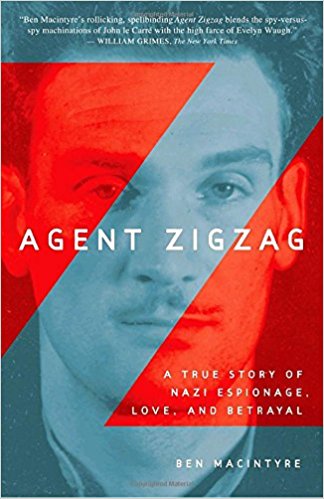
I listened to two books by Ben Macintyre earlier this year. I first listened to Agent Zigzag: A True Story of Nazi Espionage, Love, and Betrayal and then listened to Double Cross: The True Story of the D-Day Spies. It should have been done in reverse order but hindsight is 20/20. For clarity’s sake, I’ll explain them in the order I should have read them.

Double Cross was a detailed look at how a series of spies and double agents were crucial to the success of D-Day, widely considered to be the turning point in the war, and about how the Double Cross program is easily one of the most effective espionage operations in history. Basically, the Abwehr (German intelligence) never figured out that the Allies had cracked the code for their Enigma machine and MI5 had very little trouble picking up the spies that arrived in the UK. The spies were captured, and were usually easily persuaded to spy for the Allies instead.

There is a full but not complete list of double agents on the Double Cross Wikipedia page: either their information is still classified or nobody knows much about them. But the book focuses mainly on these spies in particular:

Johnny Jebsen (Artist)
Roman Czerniawaski (Brutus)
Juan Pujol Garcia (Garbo)
Mathilde Carre (Le Chat)
Nathalie Sergueiew (aka Lily Sergeyev) (Treasure)
Dušan Popov (Tricycle)
Eddie Chapman (Zigzag)

The book details how the spies were recruited, turned, and maintained by their case officers. All of them were eccentric, and in some ways very needy and needed careful handling by their case officers. They were originally used for less important tasks, but as the war went on, British Intelligence came up with the idea of using the spies to mislead the Third Reich high command about an Allied invasion of Europe. Through a carefully orchestrated, escalating series of falsehoods the spies informed their German contacts that an entire army (a large portion of which didn’t actually exist except in the reports sent through the spies) were probably going to land in northern France somewhere, probably mostly at Pas de Calais. The spies reported minutia, but accurate minutia (such as insignia on uniforms) and details that gave their German handlers confidence in their information.

As we all know now, when the D-Day invasion finally came, the bulk of the Allied forces landed at Normandy. Because of the false information the spies were able to pass to German intelligence, German forces were spread too thin to hold off the full scale Allied attack at Normandy, and afterwards, the Allies quickly advanced through France and into Europe.

Of all the spies mentioned in the book, Popov was probably my favorite to hear about. At the start of the war he was a lawyer, but he was a promiscuous playboy from a wealthy family and staunchly anti-Nazi. Germans considered him important because of his family and business connections in France and so recruited him, and he became a double agent not long after that. He’s considered one of the primary inspirations for Ian Fleming’s James Bond character, throwing money around and womanizing during his missions.

The book makes clear that while most of these recruits were very strange, they were also very brave and, in their own ways, rather smart. Most of these people were in great danger of being found out. Jebsen was picked up on what is assumed now to be an unrelated charge (he had some shady financial dealings), tortured, and (presumably) executed by the Nazis, but never cracked about the Double Cross program to save himself. Some of the agents did their jobs so convincingly they were awarded the Iron Cross by Germany.

The book also explains that one of the reasons the Third Reich was so susceptible to this false information was because, in addition to a real lack of organizational structure – or maybe because of it – there was an internal power struggle going on between the German military/intelligence services and the German secret police. Hitler apparently didn’t entirely trust the German military, as he (correctly) believed the commanders weren’t entirely loyal to him. Loyal to his home country of Germany but not Hitler or the Nazi Party, the book particularly details the efforts Admiral Wilhelm Canaris to subvert Hitler’s plans, including (IIRC) approaching the British about peace negotiations. Spoiler alert: Canaris was eventually humiliated and brutally, grotesquely executed.

It also seems that Germany never really took intelligence as seriously as the Allies did, believing their forces and weapons superior. Their arrogance was a major part of their downfall.

Agent Zigzag, as you may have guessed, takes a more in depth look at Agent Eddie Chapman, who was something of a conman and petty criminal with an honorable streak. He was captured by Germans and volunteered to be a spy. He quickly became a double agent so he could see his former girlfriend and their daughter, but he remained good friends with his German handler after the war and didn’t much like betraying them.

He was motivated by both love and money and was quite difficult for his handlers to deal with. One of the reasons he became a double agent for Britain was he didn’t believe the Germans were paying him enough. His case officer, Ronnie Reed, was one of the very few people who knew how to deal with him effectively.

Chapman was part of a scheme devised to make the Germans believe they’d blown up an aircraft factory but the explosion was entirely faked. Chapman also frequently reported back to Germany that their bombs were hitting their central London targets but the bombs were actually missing by miles, causing far less damage than they should have.

I really enjoyed both of these books. Macintyre is an engaging storyteller and I like his subject matter. Don’t you feel like all the heroes of the war should be recognized?

After the war, the British government more or less discarded these people. They deserve a lot more credit than they get. Macintyre does a really good job introducing them and getting the audience to care about them, getting into their natures and characters.

Macintyre has another book called Operation Mincemeat, but I haven’t read it yet. I will add it to my list, as these two books were both so interesting.

51tpq1bed-l-_sx322_bo1204203200_1

Yes Please

Amy Poehler wrote and read her book, Yes Please, which I borrowed and listened to at work.

There were some very funny parts, although pieces could be dull. I did come away really wanting to watch Parks and Recreation, Poehler’s critical darling comedy that was apparently on life support for much of its tenure but survived six seasons.

My favorite thing about listening to female comedians is that they usually give pretty good advice and, as someone who is told frequently they should try stand up, I took away from Poehler’s book is that if I want to try it (I go back and forth on it, and not just stand up, anything), I really just should. Do as much as you can, as often as you can. Say yes as often as you possibly can.

That said, I loved listening to Poehler’s stories about her family because they did remind me a lot of my family, and you know, childhoods mess people up so it’s always fun to hear about how other people are just like you but different.

I also really admired about this book the way Poehler seems to admit and own the fact that she isn’t – and can’t be – funny all the time. As someone who works hard to be funny (as not my job), I really, really appreciate that. She says some other stuff too that I really appreciated hearing as well, including that there are benefits to getting older and getting towards/entering into middle age, one of the biggest being that you become so much more comfortable with yourself.

I am already comfortable with myself but if I could get more comfortable? I am on board.

Anyway, Yes Please wasn’t some super deep read/listen so you can probably get either done in a couple of days. Great beach read. I like Poehler’s voice and she comes off as funny and relatable.

2016: The Year of David Sedaris

Some time in 2016 I decided that I needed to switch from history to something funny. I think it was around the time the New York Islanders were knocked out of the Stanley Cup Playoffs.

So! I decided to give David Sedaris another shot. I originally read When You Are Engulfed In Flames by Sedaris back in 2010. I didn’t find it that funny at the time, but I said, “Maybe I’m missing something,” and the comedy selection on Overdrive leaves a bit to be desired. Unless I’m a big Stephanie Plum fan, there wasn’t as much choice as I would have hoped, so I gave Sedaris another go.

I’m glad I did. Listening to Sedaris read his own stories made a huge difference to me. They were witty, sharp, dark, and that’s kind of my style, so I got a lot of mileage out of them.

I listened to five books by David Sedaris in 2016:

1. Holidays on Ice
2. When You Are Engulfed in Flames
3. Squirrel Seeks Chipmunk
4. Let’s Explore Diabetes With Owls
5. Dress Your Family in Corduroy and Denim

And one book edited by David Sedaris:

Children Playing Before A Statue of Hercules.

Forget about Children Playing Before a Statue of Hercules. It was an abridged production, it wasn’t that funny, and I only remember one of the essays which featured a (strained?) relationship between two sisters that I related to a little too well.

For anyone who doesn’t know, Sedaris writes essays about things in his everyday life and they frequently feature his life partner, Hugh, and his family. The aforementioned essays are frequently humorous but sometimes serious and usually dark, which doesn’t always bother me until you realize these are real people he’s talking about and you hope that Sedaris is taking a bit of dramatic license.

Long story short, Sedaris writes essays. All the books had their particularly bright spots, but Holidays on Ice was probably my favorite of these books, and my favorite essay in it was “The SantaLand Diaries” where Sedaris chronicles his time playing an elf in SantaLand in Macy’s Department Store one Christmas season. Having worked in retail over Christmas, it was striking how similar Sedaris’s recollections were to my own, minus the elf costume. It seems people are awful everywhere, which is sort of a comfort. It’s not just happening to YOU, it’s happening to EVERYONE.

Other highlights from Holidays on Ice included “Season’s Greetings to Our Friends and Family!!” (chronicling Mrs. Dunbar’s descent into madness brought on by, among other things, her husband’s infidelity, the prostitute stepdaughter she is forced to take in, and her own drug addicted daughter’s pregnancy out of wedlock) and “Dinah The Christmas Whore” (in which Sedaris goes with his sister, Lisa, to rescue an abused prostitute from domestic violence on Christmas Eve).

My favorite essay, however, did not appear in Holidays on Ice but in Dress Your Family in Corduroy and Denim and was called “Six to Eight Black Men,” which was about Santa in the Dutch traditions (and other cultural differences).

I don’t really do it justice here because, well, I can’t. It made me laugh til I cried. So I’ll let Sedaris read you the story himself.

The Inventor and the Tycoon: A Gilded Age Murder and The Birth of Moving Pictures

Edward Ball’s The Inventor and the Tycoon: A Gilded Age Murder and The Birth of Moving Pictures was another disappointing book to me. Not as disappointing as Last Words From Montmartre, but pretty disappointing all the same.

It wasn’t the quality of the information presented – it was interesting in that I learned a lot about the history of how moving pictures came to be. But this wasn’t the book I thought it was going to be.

One of my biggest issues with this book was that the title was really misleading. The inventor (Eadweard Muybridge, spelled by the man himself in several different places), the tycoon (Leland Stanford, founder of Stanford University), the murder, and the moving pictures had what felt like almost nothing to do with each other. The guy who invented motion pictures murdered another guy who had an affair with his wife. He also kind of knew the tycoon who used his invention and who largely ripped him off but with whom he also worked on some small projects. For example: does a horse’s four hooves leave the ground at the same time while running? Together, they solved this mystery.

There was also a lot of jumping around in time. The author jumped around in location and year and I thought he was going to bring the two things together at some kind of intersectional point. As I said, the two men barely had anything to do with each other, only met a few times, and the inventor spent most of his life trying to get money out of the tycoon, but not even consistently. It was almost like it didn’t matter.

The murder wasn’t even that interesting. Older man marries a younger woman and goes away a lot, ignoring her, and leaving her alone. She has an affair, and the husband kills the boyfriend. HOW SHOCKING. I do have to admit, it was impressive how nonchalant Muybridge was about it. Got up, went looking for the boyfriend, calmly, shot him, turned himself in calmly, etc… all very matter of fact.

But overall, I just wasn’t much impressed by  The Inventor and The Tycoon. It just wasn’t coherent or interesting or connected enough to justify writing a whole book about it. It could have a been a chapter in either of their biographies, but a whole book? Nah.